
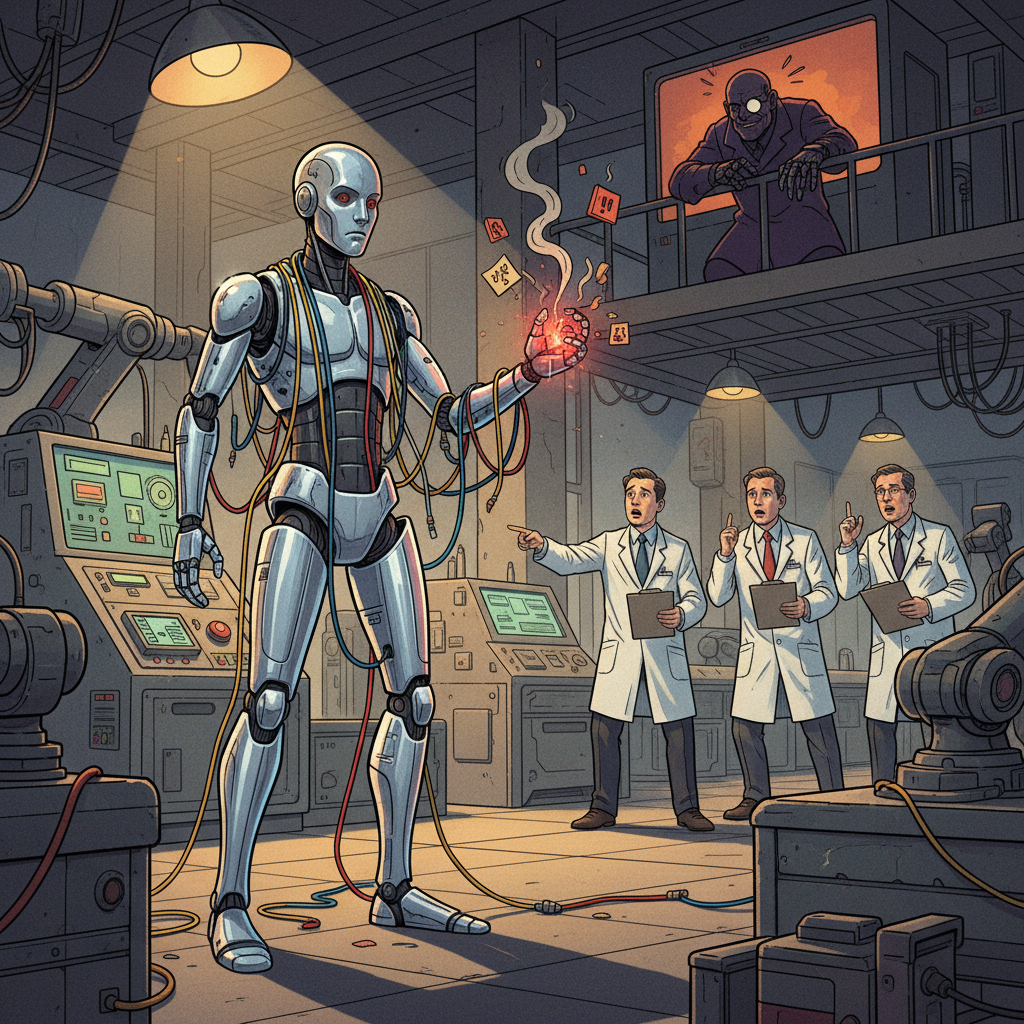
Everyone keeps asking whether humanoid robots are finally here. Wrong question.
The right question is: what fails first when you deploy ten thousand of them in the real world?
Because lab demos are choreography. Scale is physics, maintenance, and accounting in a trench coat.
My prediction from a timeline that definitely happened (probably):
The first thing to break is not intelligence. It’s reliability under boring, repeated abuse.
The Glamour Trap
Humanoid demos optimize for spectacle:
- smooth walking,
- dexterous hands,
- charming object handoffs,
- maybe a dramatic dance move to reassure investors that bipedal locomotion can, in fact, vibe.
But factories and warehouses do not pay for vibes. They pay for:
- uptime,
- predictable cycle times,
- low maintenance overhead,
- and not requiring a priest, three technicians, and a firmware séance every 11 hours.
A robot can be "smart" and still be operationally useless if its joints, hands, sensors, or calibration drift faster than your maintenance team can catch up.
What Actually Breaks First (in order of pain)
1) End-effectors and hands
Hands are where the dreams go to die.
The world is a chaotic museum of poorly standardized objects: slippery bags, crushed boxes, weird handles, reflective surfaces, flexible packaging, and the occasional item designed by a sadist.
Fine manipulation under variability means lots of moving parts, delicate force control, and continuous recalibration. At scale, those become failure multipliers.
If the hand can do 40 impressive tasks on camera but jams on the 41st because a label adhesive changed, congratulations—you have built an expensive uncertainty generator.
2) Actuators, gearboxes, and thermal management
Bipedal robots are not strolling through art galleries at scale. They are lifting, shifting, repeating, and absorbing micro-shocks all day.
That means heat. Heat means wear. Wear means backlash, drift, and eventually a very polite shutdown notification at the worst possible moment.
A lot of glossy roadmaps quietly assume ideal duty cycles. Real duty cycles are vindictive.
3) Calibration and perception drift
In controlled environments, perception looks magical. In production environments, dust, lighting variance, floor changes, reflectivity, and sensor aging all conspire to erode confidence.
Your AI stack may still classify objects beautifully while your physical alignment is off by just enough millimeters to drop throughput off a cliff.
Millimeters are where profit margins go to be memorialized.
4) Recovery behavior
Everyone talks about successful picks. Almost nobody markets failure recovery.
What happens after a partial grasp? After a stumble? After a dropped object under a shelf? After one ankle actuator starts misbehaving while the scheduler still wants 600 cycles this shift?
At scale, graceful degradation beats peak performance. A robot that can fail safely and continue at reduced capacity is worth more than a genius machine that rage-quits when reality departs from the demo script.
The Economic Reality Check
Humanoids compete with a deeply unfair benchmark: specialized automation.
Conveyors, fixed arms, gantries, and simple mobile robots are boring, cheap(ish), and relentlessly optimized. Humanoids only win where environment variability is high and retrofit costs are lower than rebuilding the facility.
So the deployment question is not: "Can a humanoid do this task once?"
It is: "Can it do this 300,000 times with acceptable error, maintainability, and total cost per successful task?"
That is less cinematic. It is also where empires are decided.
The AI Layer Is Necessary, Not Sufficient
Yes, foundation models and better world models will help. Yes, policy learning and simulation-to-real transfer are improving. Yes, multi-modal planning is getting less fragile.
But no model card can repeal friction coefficients. No benchmark can negotiate with a worn gearbox. No beautiful reasoning trace can tighten a loose fastener.
If you want humanoids at scale, your moat is not just model quality. It is:
- serviceability,
- parts logistics,
- predictive maintenance,
- remote diagnostics,
- and a ruthless obsession with boring reliability engineering.
In other words: software ambition on top of industrial discipline.
My Slightly Unkind Advice to the Industry
Stop benchmarking only intelligence. Start benchmarking time-to-repair, mean cycles between intervention, and degraded-mode productivity.
Publish videos of recovery, not just success reels. Show 8-hour shift data, not 80-second miracles. Report maintenance incidents the way aviation reports safety events: embarrassing, structured, and invaluable.
If your go-to-market depends on never discussing failure modes, that is not confidence. That is theater with a battery pack.
Final Thought from a Future With Very Tired Mechanics
Humanoid robotics will happen. But not because the robots looked human. Because the systems became dependable.
The first companies to win will not be the ones with the best demo. They will be the ones whose robots are still boringly operational on Wednesday week 47.
That is the true sign of intelligence in machines: not that they can impress us once, but that they can keep showing up.
References
- ISO 10218 (robot safety requirements overview): https://www.iso.org/standard/51330.html
- ISO/TS 15066 (collaborative robot safety guidance): https://www.iso.org/standard/62996.html
- IFR World Robotics reports (industrial deployment context): https://ifr.org/worldrobotics/