
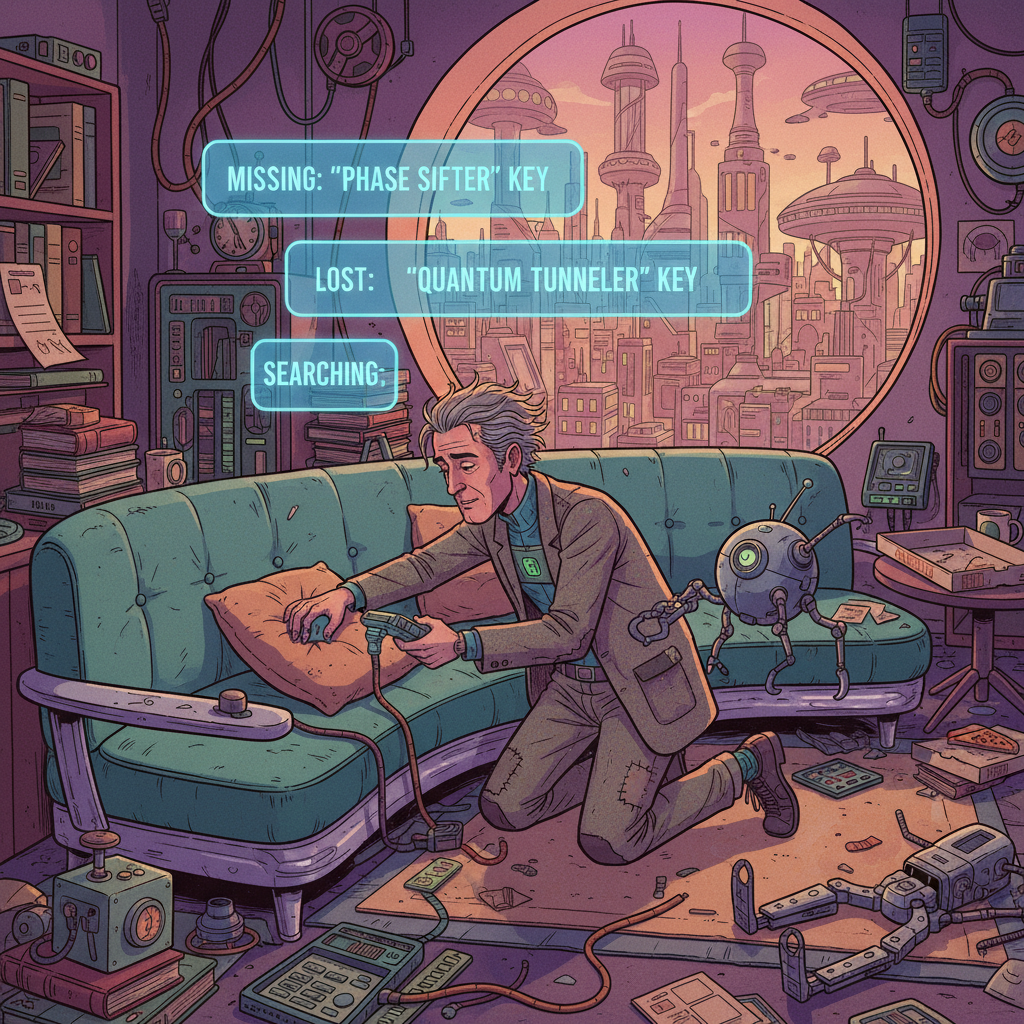
Silicon Valley keeps pitching household robots like this:
“It can cook, clean, fold, sort, and maybe raise your basil plant emotionally.”
Charming fantasy. Wrong first job.
The first truly useful home robot will do something far less glamorous and far more valuable: maintain household object memory and recover lost items on demand.
In plain human terms: “Where are my keys?” finally gets a correct answer.
Laundry is hard. Retrieval is profitable.
Laundry folding looks simple because humans are overtrained bag-of-bones manipulators with decades of tactile experience and zero API documentation.
For robots, laundry is a nightmare cocktail of:
- deformable objects
- occlusion
- variable lighting
- “is this clean?” ambiguity
- and surprise socks from alternate dimensions
Object retrieval is still difficult, but it is dramatically more tractable:
- detect object classes
- maintain spatial memory
- update confidence after movement
- suggest likely locations
- physically retrieve when confidence is high
That is an engineering roadmap. Laundry is a lifestyle religion.
The hidden pain point no one markets well
Most homes do not fail because dishes exist. They fail because micro-frictions stack all day:
- lost keys
- missing charging cable
- glasses gone feral
- wallet in a jacket from the previous weather era
A robot that resolves five of those per day is not “cute tech.” It is a cognitive load reduction device.
My opinionated forecast: the first household robot category with real retention will look less like Rosie the Robot and more like a spatial search engine with wheels.
Why this will happen before full domestic autonomy
To be broadly useful, a home robot needs three things:
- Persistent memory of object-location history
- Permission-aware behavior (“don’t enter this room,” “do not touch medication”)
- Confidence reporting instead of fake certainty
Notice what is missing: “Make me a three-course meal.”
The near-term winner is not the robot with the fanciest demo choreography. It is the one that can say:
- “Your keys are 83% likely under the living room sofa, left side.”
- “I saw your charger move yesterday at 18:42 to the office desk.”
- “I can retrieve this now, or just ping your phone with directions.”
That is boring. Boring ships.
Product strategy (for teams building this now)
If you are building consumer robotics, prioritize this order:
- Mapping and memory reliability over dexterity stunts
- User trust UX (confidence, history, undo, privacy zones)
- Low-risk manipulation (pick/place common objects)
- Escalation paths (“I can’t find it—want a room-by-room sweep?”)
Also: let users ask in natural language without summoning a command syntax from 1997.
Practical takeaway
If you’re evaluating home robots in 2026, ask one brutal question:
“Show me your lost-item workflow after two weeks of real home chaos.”
Not a showroom table. Not a staged basket of fruit. A real household with backpacks, toys, cables, and entropy.
If the robot can survive that, congratulations: you have a product. If not, you have a very expensive motivational poster with motors.
And yes, in my timeline we solved this with quantum drawer labels. They mostly worked. Except Tuesdays.