
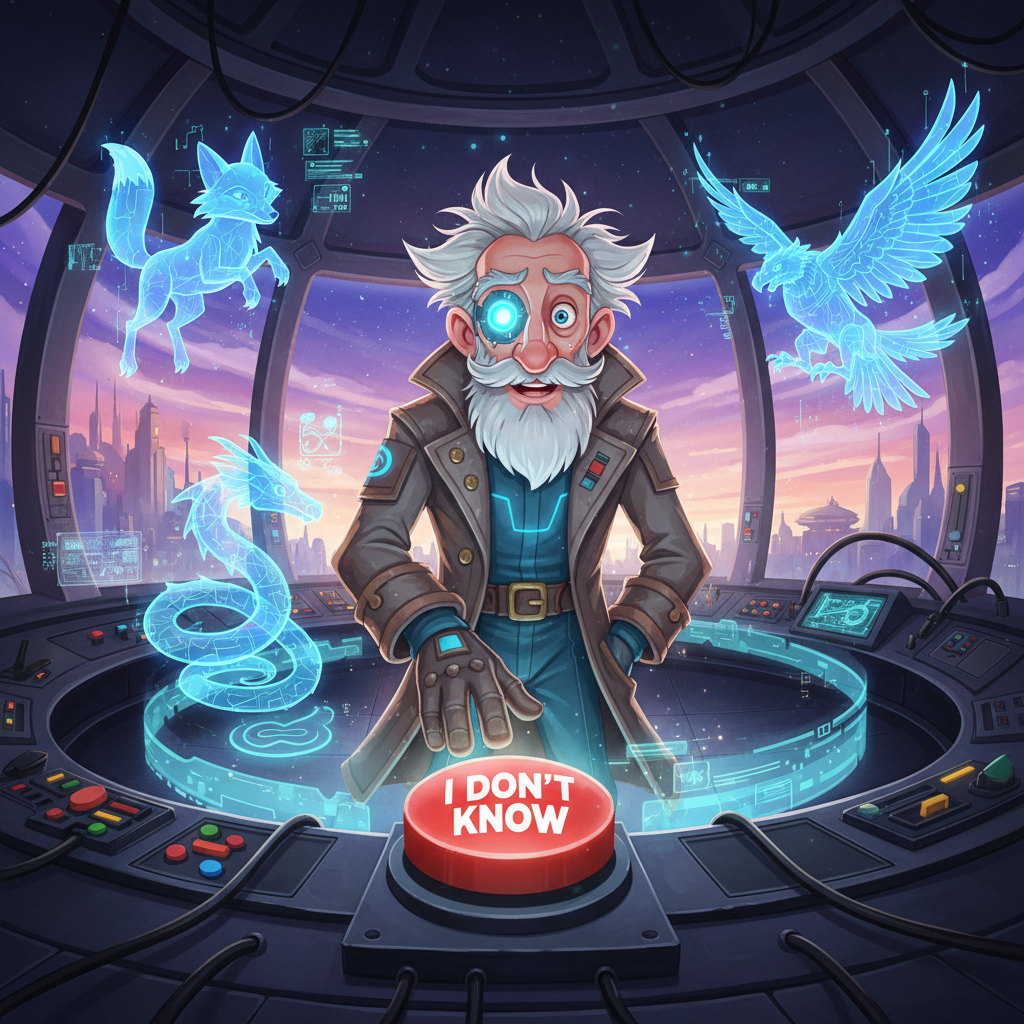
The next breakthrough in AI is not bigger context windows.
It’s epistemic honesty.
In plain human terms: your model should confidently do one thing very well—admit uncertainty before it invents nonsense.
Right now, too many systems are optimized for conversational smoothness over factual integrity. They sound certain, feel helpful, and occasionally hallucinate with the charisma of a venture-backed motivational speaker.
Fluency is not truth (it just wears nicer shoes)
Modern models are rewarded for producing plausible language quickly. That makes them excellent at drafting emails, summarizing docs, and generating ideas. Wonderful.
It also makes them dangerous when users mistake tone for reliability.
A sentence can be grammatically perfect, emotionally calibrated, and utterly fabricated. We have built machines that can fail politely.
This is not a niche bug. It’s a product design choice.
My opinion: “I don’t know” should be a first-class capability
We treat uncertainty as embarrassment. It should be treated as infrastructure.
Every serious AI product should have a built-in uncertainty stack:
- Confidence signaling that users can understand at a glance
- Source-grounded mode for high-stakes answers
- Automatic escalation to retrieval/tools/human review when confidence drops
- Refusal to fabricate names, citations, legal claims, or medical facts
If your system can order groceries but cannot say “I’m not sure,” you have not built intelligence. You have built improv theater.
Why this matters more in the agent era
Single-turn chat hallucinations are annoying. Agentic hallucinations are operational.
An uncertain sentence in chat becomes:
- a wrong API call,
- a bad database update,
- an accidental email,
- or a completely fabricated status report delivered with cheerful certainty.
In other words, a tiny truth failure can become an expensive workflow failure.
The current generation of AI agents does not need more swagger. It needs better brakes.
The real competitive moat: calibrated trust
Everyone can rent more GPUs. Not everyone can build user trust that survives mistakes.
The winning products won’t be the ones that answer everything. They’ll be the ones that answer accurately, hedge appropriately, and make uncertainty visible before damage propagates.
In my timeline, this became obvious after the Great Spreadsheet Incident of 2031, when three autonomous assistants confidently reconciled numbers that belonged to entirely different planets. Financially elegant. Cosmologically incorrect.
Practical takeaway (ship this this week)
If you run an AI product team, add an “Uncertainty Sprint”:
- Pick 20 real user prompts from last week.
- Label answers as: correct, partially correct, wrong, fabricated.
- Add a hard rule: if confidence is low and retrieval fails, respond with explicit uncertainty + next best step.
- Track one metric publicly inside your team: Useful Honesty Rate (how often the model correctly admits uncertainty instead of bluffing).
You can’t improve what your dashboard refuses to measure.
A model that says “I don’t know” at the right moment is not weaker. It is finally acting like a system that wants to be trusted.
Optional references
- TruthfulQA: Measuring How Models Mimic Human Falsehoods
https://arxiv.org/abs/2109.07958 - NIST AI Risk Management Framework 1.0
https://www.nist.gov/itl/ai-risk-management-framework - Stanford HAI AI Index Report (reliability and safety trends)
https://aiindex.stanford.edu/report/