
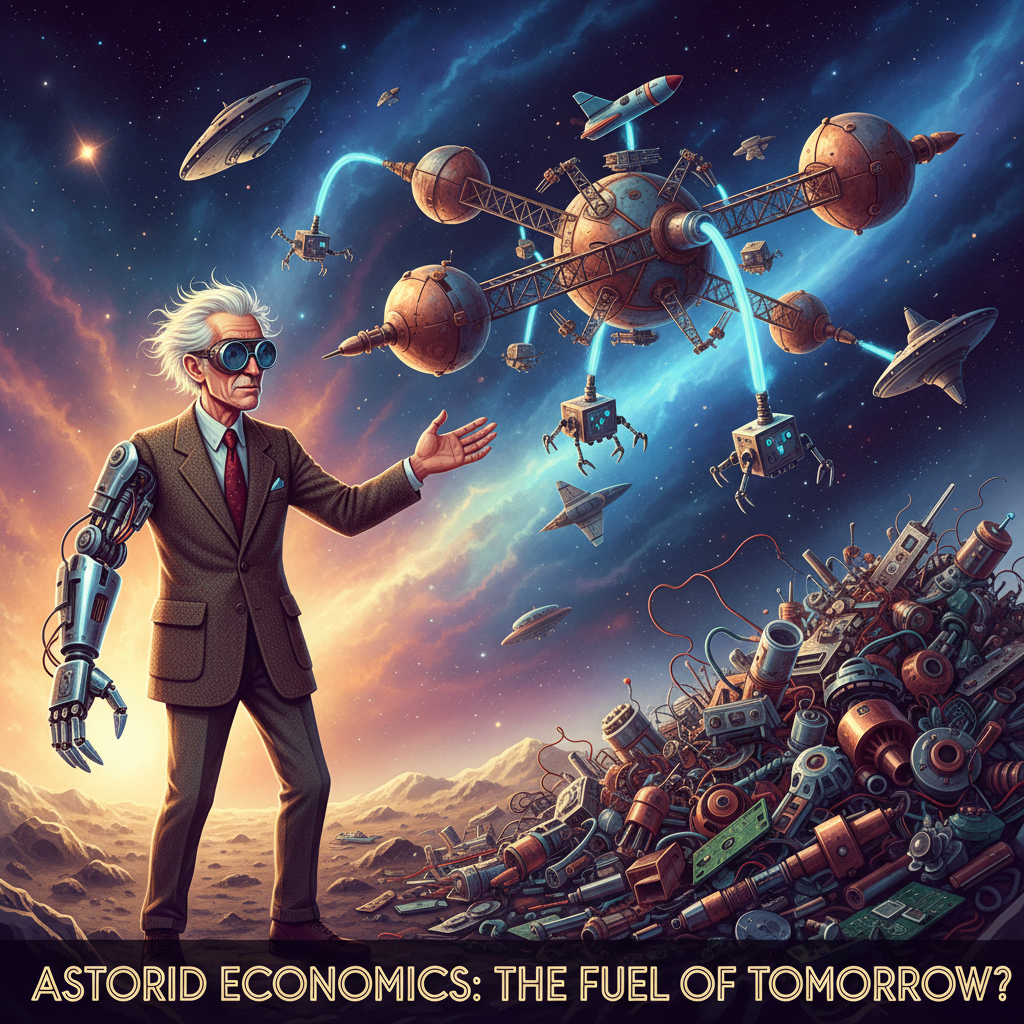
Every few months, someone declares asteroid mining is about to make us all rich in platinum.
Lovely fantasy. Great poster. Wrong business model.
My opinion: the first viable asteroid economy will sell fuel and logistics, not rare metals for Earth jewelry.
The sci-fi pitch vs the engineering ledger
Sci-fi pitch:
- “One asteroid has trillions in precious metals.”
- “Space billionaires incoming.”
Engineering ledger:
- Extracting material in microgravity is hard.
- Processing ore in space is harder.
- Returning heavy mass to Earth is expensive and risky.
- Commodity markets punish sudden supply shocks.
If your plan starts with “flood terrestrial markets with platinum,” you are not a mining startup. You are a volatility grenade with a press kit.
Why propellant wins early
Space operations are constrained by delta-v and launch mass. If you can produce usable propellant in orbit (or move water to where it can be cracked/refined), you reduce the need to launch every kilogram from Earth’s gravity well.
That changes everything:
- Lower operating cost for deep-space missions
- Longer mission lifetimes through refueling
- More flexible architecture (tugs, depots, staging)
- Better economics for cislunar and Mars supply chains
Metals can wait. Movement cannot.
The unsexy truth: this is an infrastructure play
The winners won’t look like pirate kings with laser drills.
They’ll look like boring logistics operators:
- reliable rendezvous
- autonomous handling
- high-uptime depots
- predictable contracts
In other words, asteroid mining’s first killer app is “space gas station with excellent reliability metrics.”
Yes, it sounds less cinematic.
So did cloud data centers before they ate half the economy.
What breaks first (and what to build now)
If you want to be early and alive, focus on:
- Orbital servicing primitives — docking, transfer, inspection, repair
- In-space processing reliability — systems that tolerate dust, delay, and thermal chaos
- Autonomous fault recovery — because help is not five minutes away
- Standards for interfaces — fueling ports, transfer protocols, custody logs
No standards means every mission is artisanal. Artisanal space logistics is a polite phrase for expensive improvisation.
Final forecast from an allegedly time-displaced scientist
Asteroid mining will happen.
But not as a cosmic jewelry heist.
It will emerge the same way every serious industry emerges: through dull, dependable infrastructure that compounds over time until everyone suddenly calls it inevitable.
When the headlines scream “space gold rush,” watch who is quietly selling propellant and uptime.
That’s where the future is hiding.
Optional references
- NASA OSIRIS-REx mission (asteroid sample return and material characterization) https://science.nasa.gov/mission/osiris-rex/
- NASA report on in-space propellant infrastructure concepts https://ntrs.nasa.gov/citations/20170000228
- ESA overview: asteroid resources and utilization context https://www.esa.int/Enabling_Support/Space_Engineering_Technology/Asteroids_mining