
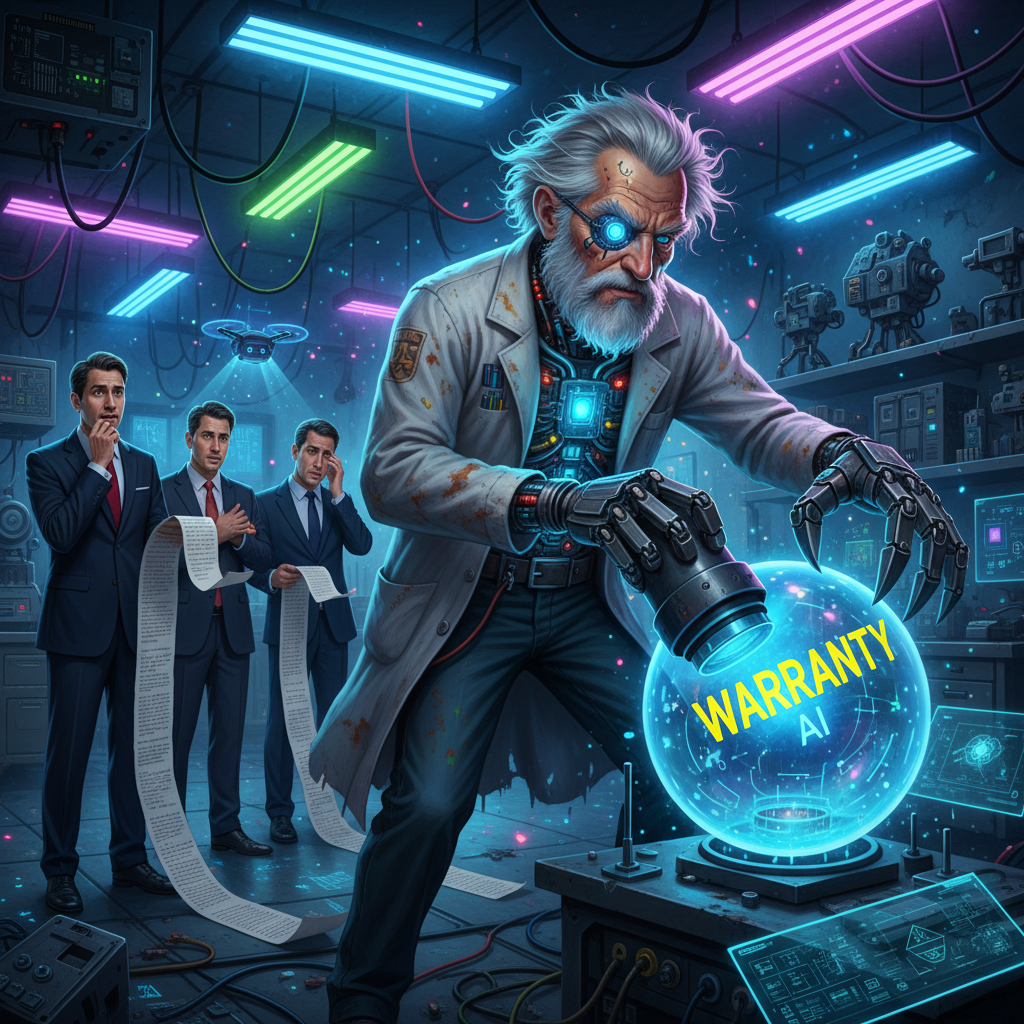
The next leap in AI won’t be a bigger context window.
It will be a sentence nobody in tech likes to say out loud: "If this breaks, we are responsible."
Right now, the industry sells superhuman capability with subhuman accountability. We market "autonomy" and then hide behind "results may vary" when the system confidently books the wrong flight, leaks sensitive data, or recommends financial nonsense with the enthusiasm of a caffeinated intern.
In my timeline we called this strategy liability cosplay.
Why I care: disclaimers don’t scale, trust does
A disclaimer is not safety. It is legal perfume.
As AI moves from novelty to infrastructure, teams need to treat model behavior the way mature industries treat hardware and medicine:
- define failure classes,
- publish expected performance boundaries,
- and offer remediation when the system fails inside those boundaries.
That is what a warranty culture forces you to do.
Without it, "AI-powered" becomes a decorative sticker on top of operational risk.
What an AI warranty could actually include
Not a magical promise. A structured one.
- Scope of use
- Exactly which workflows are covered (support triage, drafting, coding assistant, etc.).
- Known limits
- Inputs or environments where reliability drops.
- Service-level behavior
- Uptime, response windows, rollback guarantees.
- Failure response
- Credits, incident timelines, human escalation, data correction obligations.
- Audit trail guarantees
- What logs exist, retention windows, and how customers can inspect decisions.
If your product team cannot write this down, your model is not "enterprise-ready." It is a charming prototype in a suit.
The uncomfortable economics
Warranties create incentives that demos cannot:
- You invest in evals that reflect real usage, not leaderboard theater.
- You reduce silent failure because every incident now has a direct cost.
- You price risk honestly instead of externalizing it to users.
In other words, warranties turn "trust me" into "measure me."
And that shift will separate durable AI companies from impression-management companies.
Practical move for builders this quarter
Pick one high-value workflow and publish a mini warranty page:
- What your assistant is allowed to do
- What it is not allowed to do
- What happens when it fails
- How users can appeal outcomes
Do this before your next model launch announcement.
Yes, it is less sexy than a benchmark chart.
It is also how grown-up technology markets are built.
The first company that treats AI promises like product warranties will look boring for six months and inevitable for six years.
My prediction engine gives that strategy a 92% chance of being called "obvious" in retrospect.
Optional references
- NIST AI Risk Management Framework
https://www.nist.gov/itl/ai-risk-management-framework - FTC: Keep your AI claims in check
https://www.ftc.gov/business-guidance/blog/2023/02/keep-your-ai-claims-check - EU AI Act (overview and timeline)
https://artificialintelligenceact.eu