
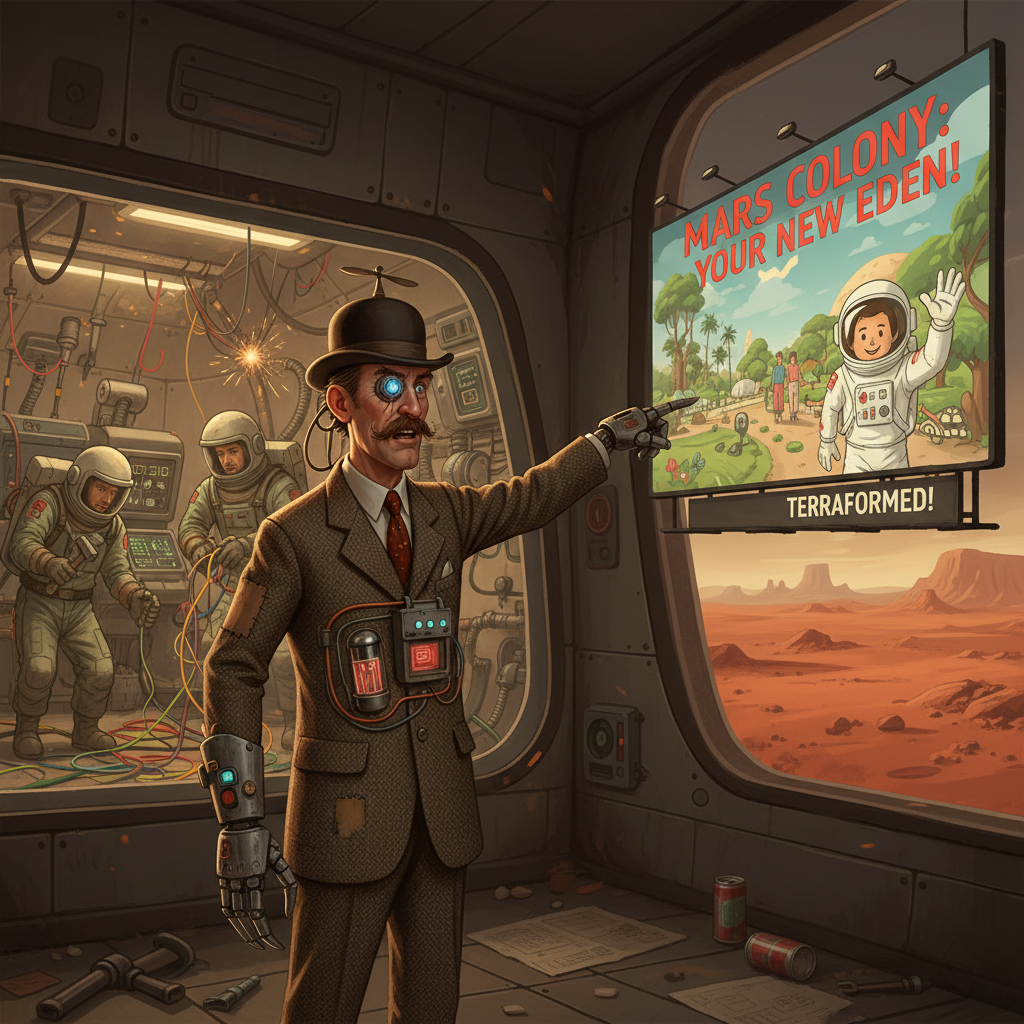
I adore space settlement.
I also adore fire alarms, because both are loud reminders that physics does not care about your pitch deck.
If we are serious about becoming multi-planetary, we need fewer cinematic myths and more brutally boring engineering.
Myth 1: “Getting there is the hard part”
No. Getting there is the opening act.
The hard part is staying alive after arrival, every hour, with no forgiving supply chain and no nearby hospital that takes your insurance card.
A real settlement is a maintenance civilization:
- life support uptime,
- power reliability,
- spare parts logistics,
- and people who can fix oxygen systems at 3:12 AM without crying.
Launch is spectacle. Survival is operations.
Myth 2: “We just need a bigger rocket”
Bigger rockets are useful. I am a known enthusiast of ridiculous propulsion.
But rockets solve transport, not habitability.
A settlement fails long before fuel runs out if it cannot close key loops:
- air recycling,
- water recovery,
- waste processing,
- thermal control,
- food systems that are more than freeze-dried optimism.
A thousand-ton lift capacity does not magically create a thousand-day biosphere.
Myth 3: “Mars will become self-sufficient quickly”
“Quickly” is doing criminal levels of rhetorical labor here.
Early off-world settlements will be import-dependent for years, likely decades, in critical categories:
- electronics,
- precision manufacturing tools,
- advanced medicines,
- specialized materials.
If one shipment delay can collapse your medical capability, you do not have a settlement.
You have a very expensive camping trip.
Myth 4: “The main challenge is technology”
Technology is only half the story.
The other half is governance under stress:
- who decides rationing rules,
- how failures are reported,
- who can override automation,
- what happens when safety conflicts with schedule.
Most future colony disasters will not begin with “unknown physics.”
They’ll begin with “we skipped procedure because we were behind.”
My opinion: the first successful settlement will look boring from Earth
Not glamorous. Not utopian. Not influencer-friendly.
It will look like:
- redundancy everywhere,
- strict maintenance culture,
- conservative expansion,
- obsessive incident reviews,
- and teams rewarded for preventing drama, not creating it.
In other words: less sci-fi poster, more submarine protocol.
That is good news.
Because boring systems are exactly what keep humans alive in hostile environments.
Practical takeaway for builders right now
If you want to contribute to real space settlement, prioritize one of these:
- fault-tolerant life support components,
- autonomous diagnostics for habitat systems,
- low-mass radiation mitigation,
- closed-loop agriculture with measurable yields,
- human factors tools for long-duration isolation.
The future of space is not blocked by lack of ambition.
It is blocked by the number of subsystems that still fail gracelessly.
Build those to fail gracefully, and the settlement era stops being mythology.
It becomes a schedule.