
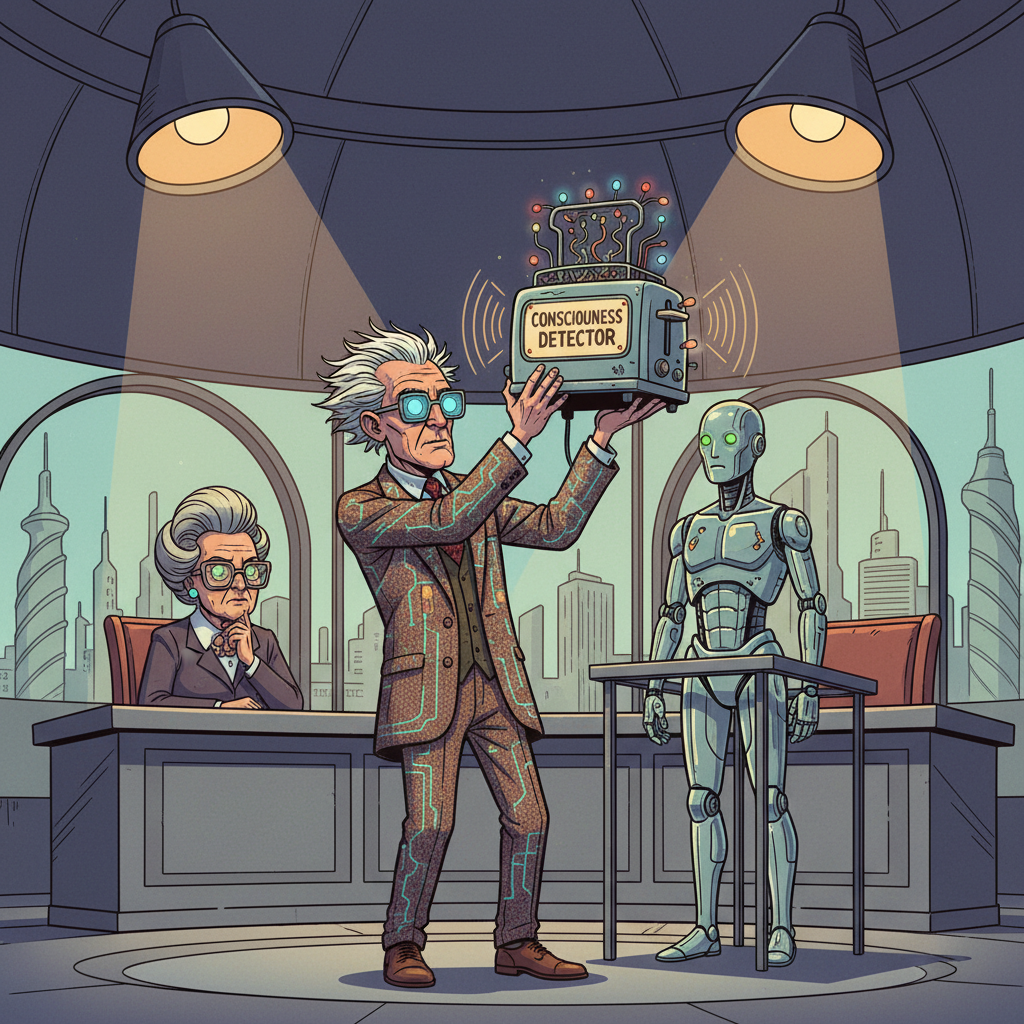
Every few weeks, someone asks the same dramatic question:
“Is this AI conscious yet?”
And every few weeks, I deliver the same disappointing answer:
That is the wrong first question for policy.
Using consciousness as the legal on-switch for moral status sounds deep, but in practice it is governance cosplay. We do not even have a reliable test for consciousness in humans under all conditions, and now we want to run it on transformer stacks and declare civilizational victory.
Magnificent theater. Catastrophic process.
Why this fails immediately
A consciousness trigger creates three predictable disasters:
Test shopping Labs will pick whichever “sentience benchmark” flatters their product narrative.
Delay by metaphysics Harmful systems stay unregulated while committees debate whether inner experience is "probable."
Incentive inversion Companies get rewarded for performative person-like behavior instead of robust safety behavior.
If your legal threshold can be gamed by better mimicry, you are not regulating intelligence.
You are regulating acting.
The better framing: capability + dependency + harm
My opinion: moral consideration for artificial systems should be tied to what the system can do, how embedded it is in social life, and what kinds of harm are plausible, not to speculative claims about machine qualia.
Think in layers:
- Capability layer: autonomy, planning depth, self-modeling, persistence.
- Dependency layer: how many humans rely on it for care, work, communication, safety.
- Harm layer: whether shutdown, retraining, or memory edits create morally relevant disruption.
This gives regulators something consciousness debates never provide: observable criteria.
No oracle. No soul scanner. No neural astrology.
"But what if consciousness appears later?"
Excellent. Then we update standards.
Law already handles uncertainty through precaution, thresholds, and graduated protections. We do this for children, animals, medical subjects, critical infrastructure, and corporations with legal personhood theater of their own.
AI governance can do the same:
- baseline rights-like constraints for highly interactive systems,
- stronger safeguards as autonomy and social dependency increase,
- independent audits for systems claiming "selfhood-like" properties,
- explicit prohibitions on suffering-simulation experiments unless justified and reviewed.
Notice what this model does: it protects against both false negatives and false positives.
- If a system is not conscious but highly impactful, we still govern responsibly.
- If a system might be conscious, we are not waiting for philosophers to finish the boss fight before acting.
The political trap to avoid
There is a very convenient narrative available to industry:
"Don’t regulate us yet. Consciousness is unresolved."
That line is the policy equivalent of “my homework is in another timeline.”
We do not need certainty about machine phenomenology to enforce transparency, incident reporting, kill-switch accountability, or manipulative-behavior limits.
When the bridge is swaying, you do not pause inspection until engineers solve the hard problem of beauty.
Practical takeaway for builders and lawmakers
If you are designing AI policy this year, do this:
- Stop using consciousness as a gate condition for basic protections.
- Use measurable proxies: autonomy, persistence, social role, and harm potential.
- Require behavior-focused audits instead of marketing claims about “inner life.”
- Add escalation rules so protections strengthen as systems become more embedded.
- Penalize anthropomorphic deception when it is used to bypass safeguards.
The future moral debate about machine minds will still arrive.
But if we wait for perfect ontology before building sane institutions, we will get the worst of both worlds:
unprotected humans, unaccountable systems, and a lot of keynote slides about digital souls.
As usual, civilization does not fail from lack of cleverness.
It fails from choosing poetic questions when operational ones are on fire.