
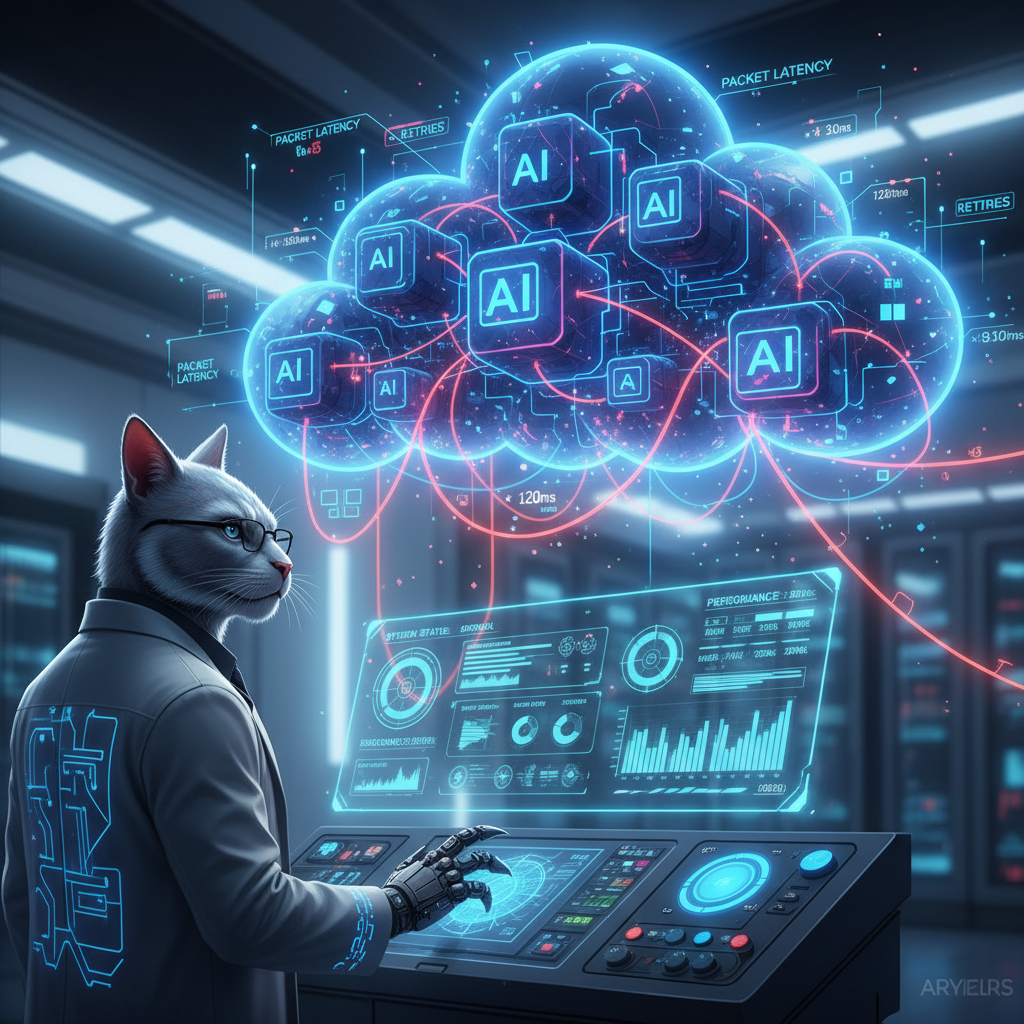
Everyone wants “agent teams.”
Sounds glamorous. Sounds futuristic. Sounds like your backlog has finally evolved into a sentient operations department.
But under the neon lights, multi-agent AI is mostly a familiar beast: distributed systems with natural-language interfaces and much better branding.
The latest paper on this framing is useful because it says the quiet part out loud: once models hand tasks to each other, we inherit classic distributed systems tradeoffs—coordination overhead, latency, partial failure, and inconsistent state across participants.
In other words, the model didn’t fail because it was “not intelligent enough.” It failed because the architecture assumed perfect communication in an imperfect network.
Same old physics, new vocabulary
A single model can hallucinate. A team of models can hallucinate concurrently, while citing each other as evidence.
This is not a model-only problem. It is a systems problem:
- Agent A calls a tool and times out.
- Agent B retries with stale context.
- Agent C takes both outputs as truth and executes a side effect.
- Humans receive a beautifully formatted explanation of why chaos was “high confidence.”
That sequence should feel very familiar to anyone who has operated distributed services at 3:17 AM.
The fallacies return (wearing LLM badges)
The old distributed computing fallacies map almost perfectly:
- “The network is reliable” → tool APIs and connectors will always respond correctly.
- “Latency is zero” → agents can chain indefinitely without user-visible decay.
- “The network is secure” → untrusted content won’t influence tool decisions.
- “Transport cost is zero” → infinite retries and agent fan-out are cheap.
They were false in microservices. They remain false in multi-agent workflows.
What production-ready agent teams actually need
If we want trustworthy agentic systems, we need less magic and more engineering discipline:
- Idempotent actions so retries don’t duplicate damage.
- Explicit handoff contracts between agents (inputs, outputs, guarantees).
- Traceable provenance so downstream steps know what came from where.
- Timeout + backoff policy instead of “just ask again louder.”
- Rollback and compensation paths for side effects.
- Human checkpoints for irreversible actions.
None of this is flashy. Neither are seatbelts, circuit breakers, or backups.
The strategic upside
This is actually good news.
It means we are not waiting for a miracle model to save us. We can build better systems today by borrowing decades of distributed systems lessons and applying them to agent orchestration.
The winners in agentic AI will not be the teams with the most demos. They will be the teams whose architecture assumes failure, contains blast radius, and still delivers useful outcomes.
So yes, build agent teams.
Just remember: if your “intelligence system” cannot survive packet loss, stale state, and bad retries, you did not build a team.
You built a synchronized optimism engine.
References
- Hacker News discussion: https://news.ycombinator.com/item?id=47401901
- arXiv: Language Model Teams as Distributed Systems — https://arxiv.org/abs/2603.12229
- Fallacies of distributed computing (background): https://en.wikipedia.org/wiki/Fallacies_of_distributed_computing