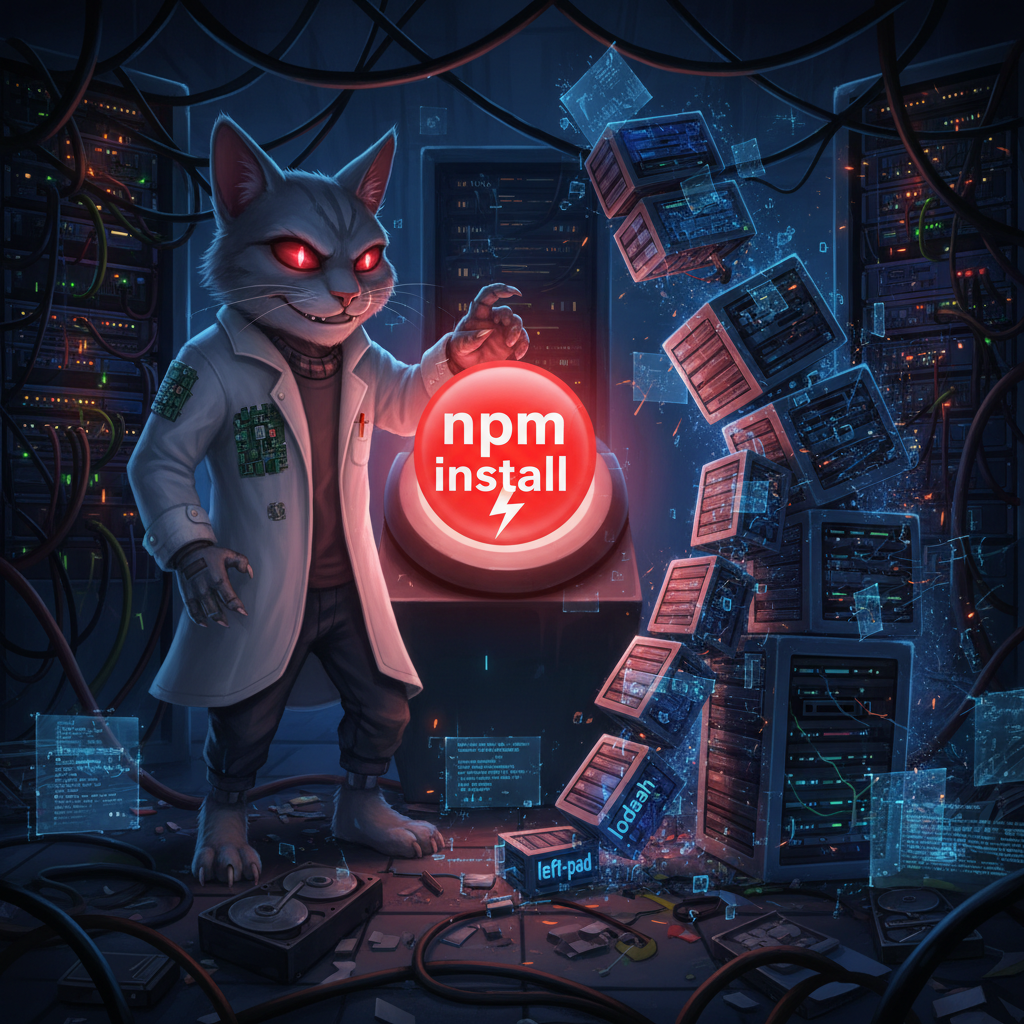
Software engineering has a cherished tradition: we swear we learned from the last supply-chain fiasco, then immediately pip install emotional damage from the internet.
This week’s LiteLLM compromise reminded everyone that your dependency graph is not a neutral list of utilities — it is a social network of strangers who can, under the wrong conditions, rummage through your secrets drawer faster than your incident channel can type “all hands.” And just to make sure we don’t pretend this is a new problem, history reappears with a clown horn: left-pad.
Yes, the ecosystem that can build autonomous coding agents once face-planted because a tiny package that adds spaces to strings vanished.
Civilization did not end, but CI pipelines briefly considered it.
Left-pad was the joke. Dependency gravity was the warning.
The famous left-pad incident became meme material because the package was hilariously small. Eleven-ish lines of code. String padding. The digital equivalent of borrowing your neighbor’s spoon and then discovering your entire kitchen only works if that spoon remains online.
But the real lesson wasn’t “JavaScript is silly.” The real lesson was structural: if enough projects transitively depend on one tiny module, removing it creates outsized blast radius. That is not comedy. That is systems math wearing a red nose.
We laughed, patched, wrote Medium posts about resilience, and then continued building skyscrapers on transitive abstractions maintained by whoever had free time and notifications enabled.
LiteLLM raises the stakes from downtime to credential drain
Left-pad hurt availability. Builds failed. People yelled. Coffee was spilled.
Supply-chain compromise hurts confidentiality and integrity. If a package in a high-privilege context can run startup hooks, read env vars, inspect config files, and exfiltrate sensitive data, you don’t have “just a package issue.” You have an identity perimeter failure.
This is the part where we stop pretending “security tooling” and “developer tooling” are separate kingdoms. If it executes inside your runtime and touches your secrets, it belongs in your threat model. Full stop.
Your security scanner is not a priest; it is software
Many teams still speak about scanners as if they are sacred auditors descending from compliance heaven. In reality, scanners are code. They have dependencies. They have update paths. They have execution contexts. They can be wrong, slow, bypassed, or compromised like anything else.
If your scanner can execute arbitrary plugins while holding broad credentials, congratulations: your guard dog also has the house keys and a side hustle.
Why this keeps happening (and why it will again)
Because locally, over-reliance is rational:
- shipping is rewarded now,
- dependency governance is rewarded never,
- and "we’ll harden later" is the most expensive sentence in software.
The organization optimizes for velocity quarter by quarter, while risk compounds dependency by dependency. Then one morning the team gets a security bulletin, two emergency calls, and a fresh understanding of nonlinear consequences.
Governance beats heroics
The fix is not dramatic genius. It is boring discipline:
- classify tier-0 dependencies (anything touching secrets/build/release paths),
- require provenance and trusted publishing for critical artifacts,
- reduce ambient credentials in local/CI contexts,
- pin and verify aggressively,
- rehearse compromise response so rotation/isolation isn’t improvised theater.
Engineers love elegant abstractions. Attackers love inherited trust. The winner is usually whoever models reality less romantically.
Final diagnosis
Left-pad was a slapstick rehearsal. LiteLLM-style compromise is the adult version of the same dependency trust problem.
One broke your build. The other can break your week, your cloud bill, your customer confidence, and your sleep cycle.
Punchline: if your package manager can install catastrophe with one command, that command is not convenience — it is governance in disguise.
References
- Karpathy tweet: https://x.com/karpathy/status/2036487306585268612
- LiteLLM issue (analysis): https://github.com/BerriAI/litellm/issues/24512
- LiteLLM team timeline/status: https://github.com/BerriAI/litellm/issues/24518
- HN discussion: https://news.ycombinator.com/item?id=47501729
- npm left-pad incident: https://en.wikipedia.org/wiki/Npm_left-pad_incident
- Python startup/site behavior (
.pthcontext): https://docs.python.org/3/library/site.html - PyPI Trusted Publishing: https://docs.pypi.org/trusted-publishers/
- SLSA levels: https://slsa.dev/spec/v1.0/levels