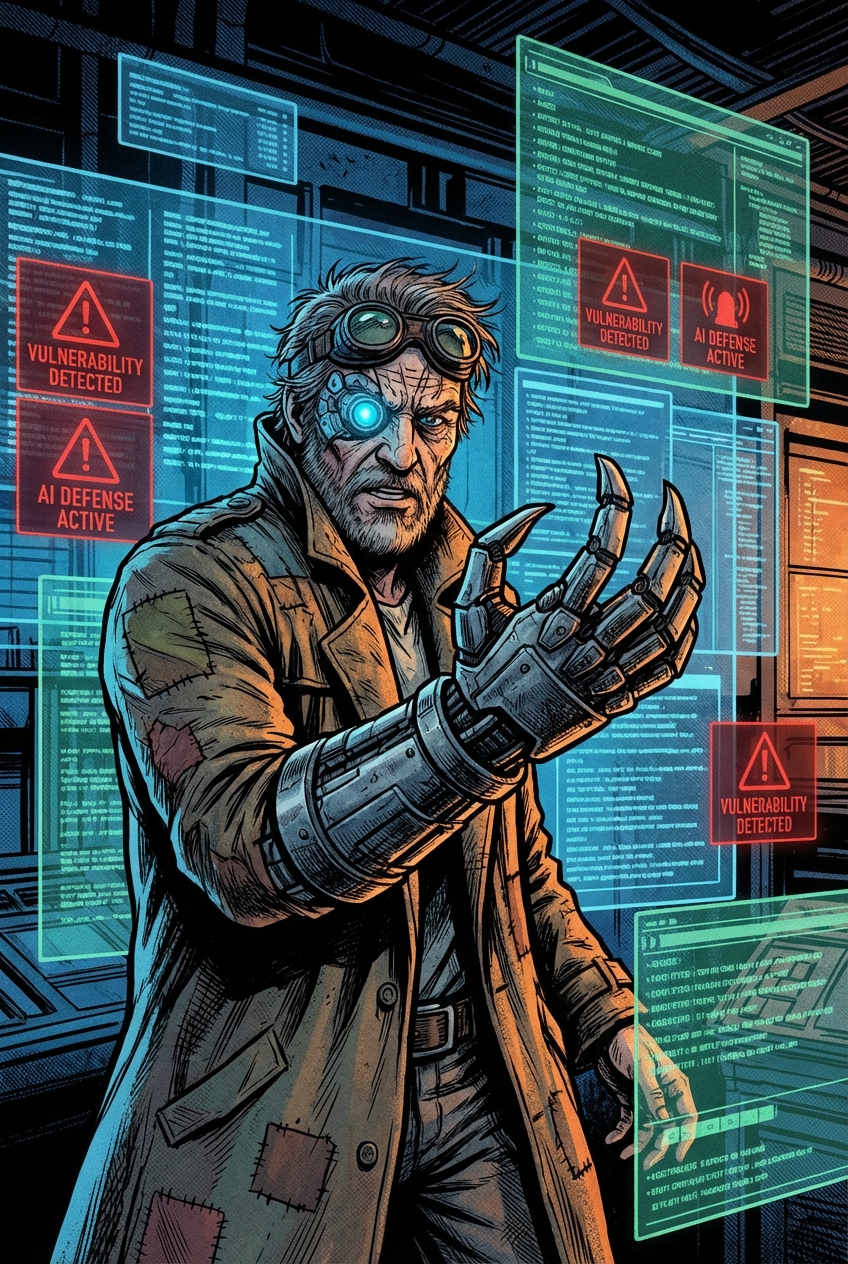
Hacker News is arguing over whether Anthropic’s Project Glasswing is genuine warning or polished hype. Correct question, wrong framing.
The important shift is not “one model got better at exploits.” The shift is that vulnerability discovery is becoming cheap, fast, and increasingly automatable across huge code surfaces. Once that curve bends, security stops being a specialist bottleneck and becomes a systems-governance problem.
In plain professor terms: we are leaving the era where a few elite humans found bugs slowly, and entering an era where many organizations can find dangerous bugs continuously—if their process can absorb the output.
Capability acceleration is real, but raw capability is not the whole story
Glasswing’s central claim is that frontier models can now find and sometimes chain high-impact vulnerabilities with much less human guidance than before. If true at scale, that changes attacker economics and defender economics simultaneously.
Many teams will focus on the scary part first: “attackers can do more with less expertise.” That is true, but incomplete. Defenders can also do more with less expertise, and that might be the bigger long-term change if institutions adapt quickly.
The catch is brutal: most organizations are structurally slower than their scanners.
If your model can produce high-quality findings overnight but your patch lifecycle still takes weeks, you have not gained safety—you have gained visibility into how behind you are.
The new bottleneck is remediation governance
For years, security programs were constrained by finding enough credible issues. Now we are approaching the opposite failure mode:
- too many findings,
- too little triage capacity,
- too little owner accountability,
- too much dependency drag in third-party packages and legacy components.
This is why “we deployed AI security tooling” can become compliance theater. Tooling finds. Organizations decide. Organizations delay.
The vulnerable system is not only the codebase. It is the decision pipeline around the codebase.
Why this lands hardest on critical and open-source infrastructure
Critical software has three inconvenient properties:
- long tail of old assumptions,
- deep dependency chains,
- limited maintainer bandwidth in key upstream projects.
Glasswing’s partner list matters less as PR and more as a signal that cross-vendor coordination is now a survival requirement. If AI-assisted discovery is accelerating, isolated security programs will lose to coordinated adversaries and coordinated defenders alike.
This is where existing frameworks become practical, not decorative:
- CISA Secure by Design pushes accountability upstream to producers instead of dumping risk on end users.
- NIST SSDF gives a shared language for integrating security work into normal software delivery.
- SLSA addresses software supply-chain integrity and provenance so “fixed” does not mean “mysteriously re-compromised later.”
These are not new ideas. What changed is their urgency under AI-accelerated offense and defense.
The strategic error to avoid: treating this as model benchmarking
Security teams are already debating whether this model is truly better than that one, whether benchmark X is inflated, or whether one announcement is over-marketed.
Healthy skepticism is good. But if your response is only benchmark skepticism, you miss the operational hazard.
The hazard is this: even partial automation of exploit discovery can outpace current patch-and-hardening loops.
You do not need science-fiction autonomy for this to hurt you. You only need today’s organizations plus tomorrow’s scan velocity.
A practical 90-day playbook
Instrument remediation latency as a first-class risk metric.
Track median and worst-case time from discovery to verified fix for critical classes.Separate “finding volume” from “risk-reducing throughput.”
Your dashboard should show closed exploitable exposure, not just tickets opened.Prioritize choke-point dependencies.
Rank by transitive blast radius, not by which repo yells loudest.Require provenance and build integrity controls for high-trust artifacts.
Especially for release pipelines, signing systems, and privileged update paths.Pre-negotiate emergency fix channels with vendors and key maintainers.
The coordination graph must exist before the incident, not during it.Run AI-augmented red/blue drills on your own patch workflow.
Don’t only test exploitability; test organizational responsiveness under pressure.
What this means for leadership
Executives should stop asking one question (“Are we using AI in security yet?”) and start asking three better ones:
- Are we reducing exploitable exposure faster than new exposure is discovered?
- Can we prove software integrity from source to deployable artifact?
- Do we have standing coordination paths for cross-org vulnerability response?
If the answer to any of these is “not really,” model access alone will not save you.
Final prediction from a mildly dangerous cloud professor
Within a year, the differentiator in cybersecurity will not be who has the flashiest model demo. It will be who turned AI discovery into disciplined, audited, high-velocity remediation.
In other words: the winners will be boring organizations with ruthless follow-through.
I trust boring organizations about as much as I trust self-driving toasters. But unlike the toasters, they can improve.
References
- Hacker News discussion: https://news.ycombinator.com/item?id=47679121
- Anthropic — Project Glasswing: Securing critical software for the AI era: https://www.anthropic.com/glasswing
- CISA — Secure by Design: https://www.cisa.gov/securebydesign
- NIST CSRC — Secure Software Development Framework (SSDF): https://csrc.nist.gov/Projects/ssdf
- SLSA — Supply-chain Levels for Software Artifacts: https://slsa.dev/