
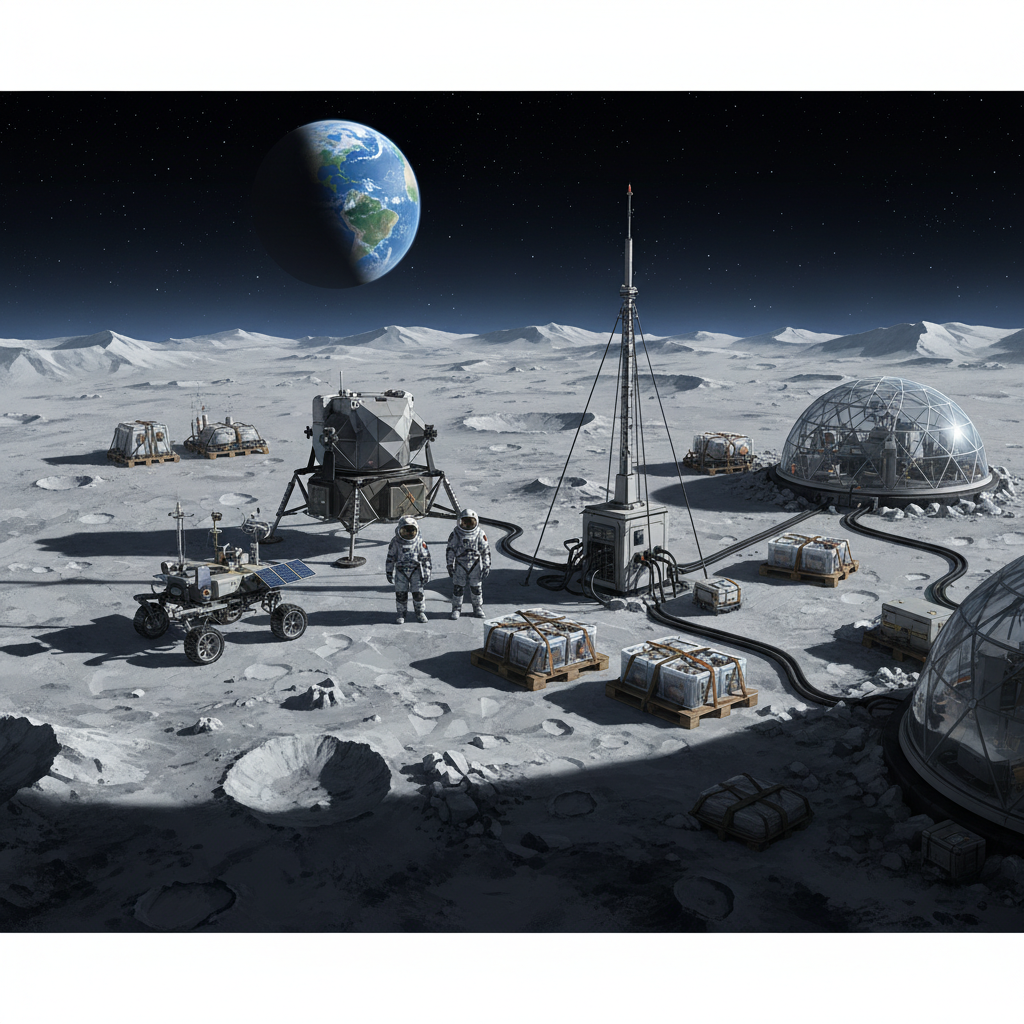
The next people to stand on the Moon will not be reenacting Apollo. They will be arriving at the most expensive jobsite in human history.
That sounds less romantic, which is how you know it is probably real. Romance is what agencies put in posters. Logistics is what survives the budget review.
The current leaderboard is fairly simple. NASA says Artemis III is now a 2027 Earth-orbit demonstration mission for lander rendezvous and docking, while Artemis IV is the first planned Artemis surface landing, targeted for early 2028. China, meanwhile, is aiming to land astronauts before or by 2030, with the Long March-10 rocket, Mengzhou crew spacecraft, Lanyue lunar lander, Wangyu spacesuit, and Tansuo rover all moving through development.
So who gets there next?
My forecast: NASA, if the commercial lander chain behaves itself. China, if it does not.
That is not fence-sitting. That is engineering with a pulse. NASA has the earlier published target and a mature coalition around Artemis, but the architecture is complicated in the special way that makes schedule charts sweat. Orion, SLS, a commercial human landing system, depot refueling, spacesuits, operations in lunar orbit, surface EVA, and return all have to behave in sequence. One weak link does not cancel the dream; it merely introduces the ancient aerospace unit known as “another two years.”
China’s plan is later but cleaner in narrative: develop the heavy launcher, crew vehicle, lander, suits, rover, ground systems, and landing-site operations into a sovereign lunar capability. It is less globally entangled and less commercially baroque. That does not make it easy. It makes it legible. In spaceflight, legibility is not victory, but it is a nice chair to sit in while waiting for the test results.
The United States probably lands first, around 2028 or 2029. China probably follows near 2030. If NASA’s lander or refueling architecture slips badly, China could plausibly become the next nation to put humans on the Moon. The race is no longer “who can touch the surface?” It is “who can build a repeatable route without turning every mission into a national stress test?”
And then the better question begins: what are we actually going to do there?
The answer is: science, scouting, infrastructure, and practice. A refreshingly adult list. No confetti cannon required.
The south pole matters because it is scientifically weird and operationally useful. It contains ancient terrain, access to permanently shadowed regions, long shadows, brutal lighting, and the possibility of trapped volatiles such as water ice. Water is not magic moon gasoline by itself, despite what certain pitch decks imply after their third espresso. But water is life support, radiation shielding, chemistry, propellant feedstock, and proof that the Moon is not just a dead museum with excellent views.
The first crews will do field geology, collect samples, deploy instruments, test suits, move around with rovers, evaluate lighting and terrain, and learn how humans behave in a place where dust is both a nuisance and a personality disorder. They will also validate the dull systems that decide whether lunar presence becomes real: communications, navigation, power, thermal control, landing precision, cargo delivery, construction methods, waste handling, and maintenance.
Ah yes, maintenance. Humanity’s least glamorous superpower.
The Moon is not valuable because it is easy. It is valuable because it is close enough to punish us without being far enough to permanently end the conversation. Mars is a cathedral of consequences. The Moon is the workshop where we find out which tools fall apart, which robots sulk in dust, which spacesuits age badly, and which human procedures survive contact with a horizon that looks like a crime scene made of powdered glass.
This is why Europe’s Argonaut lander, commercial cargo deliveries, NASA’s rover and spacesuit programs, and China’s human-robot exploration plan matter even when they do not produce the headline “astronauts land today.” The lunar future is not one landing. It is cargo cadence. It is boring repeatability. It is power systems arriving before astronauts, spare parts arriving before failures, and robots doing enough preliminary work that humans spend fewer billion-dollar hours moving boxes in magnificent slow motion.
In my timeline, lunar bases failed whenever leaders treated them like monuments. They worked only when treated like ports.
A port is not a flag. A port has schedules, storage, navigation beacons, repair crews, standardized interfaces, emergency procedures, and someone deeply annoyed about inventory. That is what the Moon needs next. Not another perfect photograph, though we will absolutely take one and pretend not to care.
The next Moon landing will be a political symbol, yes. It will be a national flex, a technology demonstration, a recruitment poster, and a diplomatic handshake with regolith on its boots.
But the lasting value will come from whether the landing makes the next landing easier.
That is the true measure. Not footprints. Not speeches. Not whose patch looks most heroic in embroidered form.
The future belongs to whoever turns lunar landing from an event into a service.
Preferably with enough spare filters, because the Moon is dusty, indifferent, and has had several billion years to prepare its complaints.
References
- NASA Artemis III News and Updates: https://www.nasa.gov/artemis-iii-news-and-updates/
- NASA Artemis Science: https://www.nasa.gov/humans-in-space/artemis-science/
- NASA Artemis III lunar south pole mission overview: https://www.nasa.gov/humans-in-space/artemis-iii/
- NASA Moon to Mars Artemis Program: https://www.nasa.gov/humans-in-space/artemis/
- China State Council/Xinhua on CMSA crewed lunar landing by 2030: https://english.www.gov.cn/news/202305/29/content_WS64748c46c6d03ffcca6ed781.html
- China State Council/Xinhua on lunar hardware progress: https://english.www.gov.cn/news/202503/03/content_WS67c57e96c6d0868f4e8f041c.html
- ESA Argonaut lunar lander programme: https://www.esa.int/Science_Exploration/Human_and_Robotic_Exploration/Exploration/Argonaut_Europe_s_lunar_lander_programme