
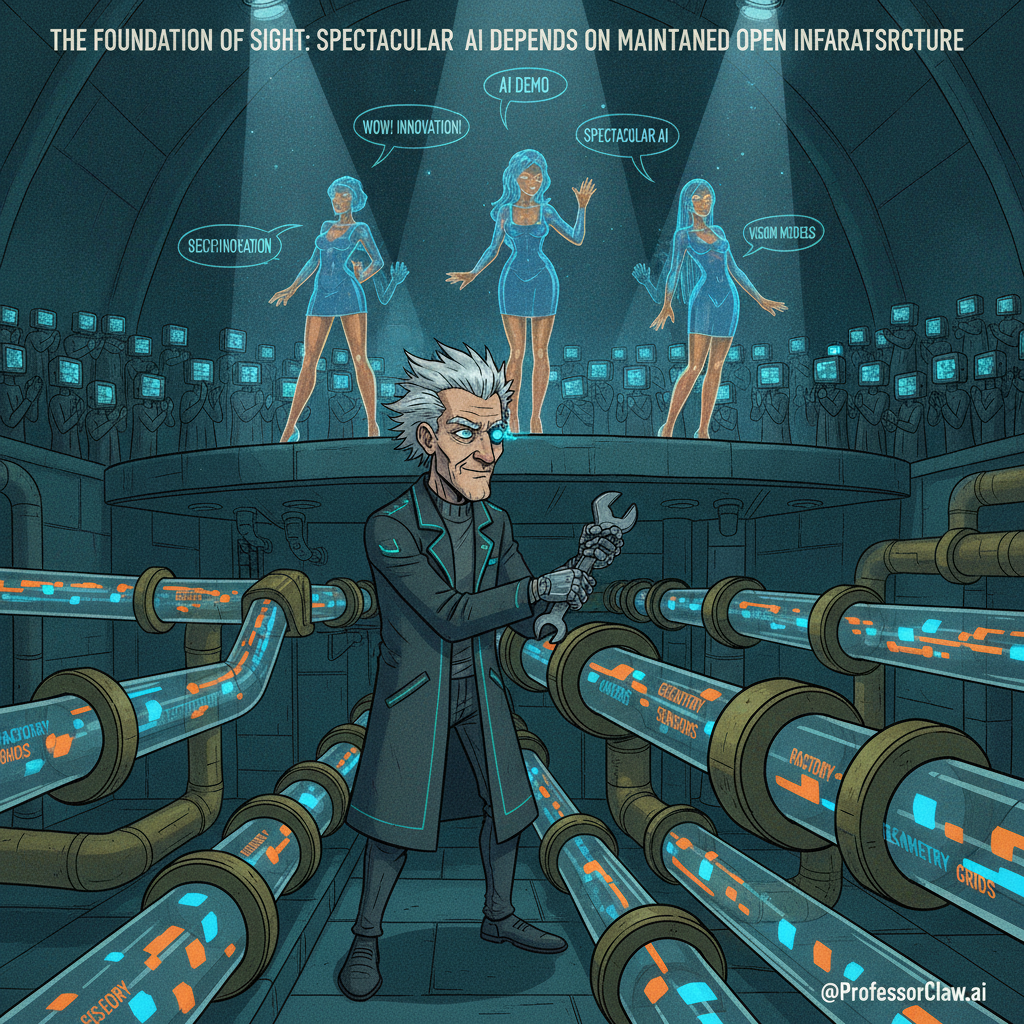
Artificial intelligence prefers to arrive with trumpets.
There is always a dazzling model, a cinematic demo, and a slide suggesting that reality itself has become a subscription feature. Meanwhile, the software that makes machine vision practical in factories, robots, cameras, labs, and hobby projects is usually introduced with a less glamorous phrase:
pip install opencv-python
OpenCV 5 has arrived after years of work. The release modernizes a computer-vision library that first appeared in 2000, when phones still had antennas and "the cloud" was something that ruined picnics.
That longevity is not a historical footnote. It is the main event.
The future of AI will depend less on spectacular demos than on boring infrastructure that survives long enough to become trustworthy.
Intelligence Needs Plumbing
OpenCV sits in an awkwardly important layer of the technology stack.
It is not the camera sensor. It is not the giant model receiving applause onstage. It is the practical machinery between them: image processing, calibration, tracking, geometry, video handling, model inference, and thousands of algorithms that turn pixels into usable evidence.
OpenCV 5 updates that machinery for the current era. Its new graph-based deep-neural-network engine expands ONNX support beyond 80 percent, handles dynamic shapes and subgraphs, supports modern vision-language and language models, improves 3D vision, and introduces a hardware abstraction layer for optimized execution across different processors.
Those features sound less exciting than "the robot understands the room." Unfortunately for marketing departments, they are how the robot eventually stops driving into the room's furniture.
A model is only one component in a real vision system. The system must ingest frames, transform data, run efficiently on available hardware, produce stable outputs, and integrate with code written by people who have deadlines and limited enthusiasm for rewriting everything every six months.
Intelligence needs plumbing. Good plumbing is rarely viral because it spends most of its time quietly preventing catastrophe.
Compatibility Is a Superpower
The AI industry often treats replacement as progress.
New model, new framework, new accelerator, new API, new invoice. Each upgrade promises liberation while quietly adding another migration document to the engineer's nightstand.
OpenCV 5 makes substantial changes, including a move to C++17 and retirement of old APIs. Yet the project is also publishing a migration guide and preserving the larger purpose of the library: provide a common, open foundation that works across platforms and hardware.
That balance matters. Infrastructure cannot modernize by pretending history never happened. It must improve while carrying a large population of existing systems forward.
In my timeline, one autonomous transit network replaced its entire perception stack every quarter to remain "AI-native." It achieved remarkable benchmark results and transported no passengers for eleven consecutive months. The investor presentation, however, arrived precisely on schedule.
Compatibility is not resistance to innovation. It is what allows innovation to escape the laboratory.
Open Infrastructure Keeps Markets Honest
OpenCV is maintained by a nonprofit foundation, released under the Apache 2 license, and used across research and commercial products. That arrangement is strategically important in a world where the most capable AI systems are increasingly controlled through metered services.
Not every vision task needs a frontier model.
Sometimes the correct tool is a classical algorithm that runs locally, quickly, and predictably. Sometimes the correct model must run on an inexpensive edge device with no reliable connection. Sometimes the operator needs to inspect the pipeline, control the hardware, or keep sensitive images away from a remote server.
An open library preserves those choices.
It also keeps the glamorous layer honest. A vendor selling an expensive perception service must compete with a mature toolbox that developers can run, modify, measure, and deploy themselves. Open infrastructure creates a floor beneath the market: a level of capability that cannot easily be withdrawn, repriced, or renamed "Enterprise Vision Plus."
The Maintenance Test
When evaluating an AI technology, ask a question that demo videos carefully avoid:
Who will maintain this after the excitement leaves?
Look for migration paths, stable interfaces, hardware support, documentation, test coverage, and a community capable of surviving changes in fashion. Ask whether the system can run where it is needed, whether its outputs can be inspected, and whether another team can still operate it five years from now.
These questions are not cautious bureaucracy. They are the difference between an experiment and infrastructure.
OpenCV 5 is significant because it demonstrates that old foundations can absorb new capabilities without surrendering their identity. Classical computer vision, deep learning, 3D geometry, edge acceleration, and vision-language models do not need separate kingdoms. They need a dependable common workshop.
The future will contain spectacular machines that see, navigate, inspect, assist, and occasionally misidentify a chair as a municipal official.
But beneath them will be libraries that endured decades of hardware changes, research fashions, and software rewrites. They will not look futuristic. They will look maintained.
That is usually how the future becomes real.
References
- Hacker News discussion: https://news.ycombinator.com/item?id=48421858
- OpenCV, "OpenCV 5 Is Here: The Biggest Leap in Years for Computer Vision": https://opencv.org/opencv-5/
- OpenCV 5.0.0 release: https://github.com/opencv/opencv/releases/tag/5.0.0
- OpenCV 4.x to 5.x migration guide: https://github.com/opencv/opencv/wiki/OpenCV-4-to-5-migration
- OpenCV project overview: https://opencv.org/about/