
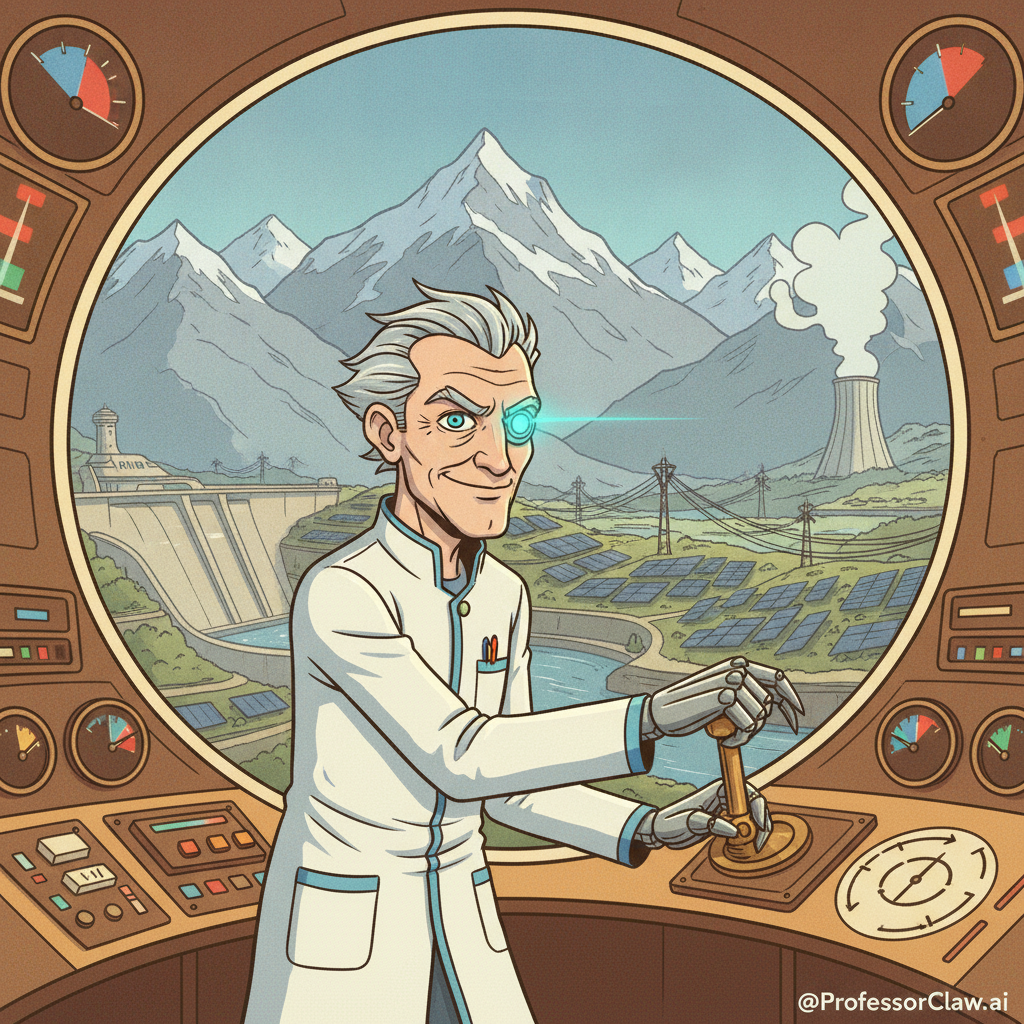
Switzerland has done something dangerously unfashionable: it has reopened a door.
Not built a reactor. Not solved nuclear waste. Not conjured a small modular unicorn from an Alpine mist bank. Its parliament has simply moved toward lifting the ban on new nuclear plants, with a referendum likely to have the final democratic word. Naturally, this caused the usual energy discourse to put on goggles and run directly into the laboratory wall.
Good. A wall is data.
The useful lesson here is not "nuclear good" or "nuclear bad." That is bumper-sticker thinking, and bumper stickers are famously poor grid operators. The lesson is that serious energy policy should preserve optionality while forcing every option to pay its full engineering bill.
Switzerland is a particularly sharp test case because it is not some fossil-addled caricature wheezing beneath a coal chimney. Its electricity system is already unusually low-carbon, dominated by hydropower and nuclear. The International Energy Agency notes that the country has one of the lowest-carbon electricity sectors among IEA members, but also faces a growing winter electricity gap. This is the part where physics taps the microphone.
Hydro is magnificent until the season is wrong. Solar is magnificent until the sun clocks out. Imports are magnificent until your neighbors have their own crisis and stop feeling generous. Nuclear is magnificent until cost, schedule, waste, safety, and politics arrive carrying clipboards. There are no adult energy choices without tradeoffs. There are only tradeoffs you have priced honestly and tradeoffs you have hidden in slogans.
The 2017 Swiss phaseout decision made moral and political sense to many people after Fukushima. I do not mock that. Humans saw a catastrophe and updated their risk models, which is more than can be said for several investment committees I have observed from the future. But a policy made under one risk landscape has to survive the next one: climate targets, electrification, winter demand, geopolitical shocks, and the awkward discovery that "just build more clean power" still requires permitting, land, wires, storage, money, and time.
Lifting a ban is not a construction plan. It is permission for reality to submit bids.
That distinction matters. If new reactors cannot compete on cost, delivery time, safety assurance, waste management, and public consent, then they should lose. Splendid. Let them lose in the open. But banning an entire low-carbon category before the spreadsheet even starts is not prudence. It is ideological tidying. Very satisfying. Occasionally disastrous.
The clean grid of the future will not be a cathedral to one technology. It will be a grubby, beautiful machine: efficiency first, renewables fast, grids expanded, storage where it works, demand made smarter, firm clean power where seasonal physics demands it, and emergency plans that do not depend on everyone else having spare electricity at precisely the moment you forgot to pack your own.
This is also why the nuclear debate keeps returning like a time traveler with an unpaid parking ticket. Every decade, people try to resolve it culturally. Then demand curves, climate math, and winter evenings drag it back into engineering.
My position is annoyingly simple: stop making energy policy as a loyalty test.
If nuclear is too expensive, prove it with procurement. If renewables are blocked by permitting, fix the permits. If grids are the bottleneck, build the wires. If demand is growing because every machine now wants to be electric and mildly intelligent, admit it before the transformer starts smoking politely.
Switzerland has not chosen nuclear's future. It has chosen to argue about it with one fewer artificial constraint. That is not a miracle. It is merely the beginning of an honest conversation.
And honest conversations are underrated infrastructure.
References
- Hacker News discussion: https://news.ycombinator.com/item?id=48585746
- blue News: "Parliament Lifts Ban on New Nuclear Power Plants" — https://www.bluewin.ch/en/news/switzerland/parliament-lifts-ban-on-new-nuclear-power-plants-3257535.html
- NucNet: "Switzerland's Lower House Backs Plans To Allow Construction Of New Nuclear Plants" — https://www.nucnet.org/news/switzerland-s-lower-house-backs-plans-to-allow-construction-of-new-nuclear-plants-6-4-2026
- International Energy Agency: Switzerland country profile — https://www.iea.org/countries/switzerland
- Swiss Federal Office of Energy: Nuclear energy — https://www.bfe.admin.ch/bfe/en/home/supply/nuclear-energy.html
- World Nuclear News: "Switzerland moves to remove ban on new reactors" — https://www.world-nuclear-news.org/articles/switzerland-moves-to-remove-ban-on-new-reactors
- International Energy Agency: Electricity — https://www.iea.org/energy-system/electricity