
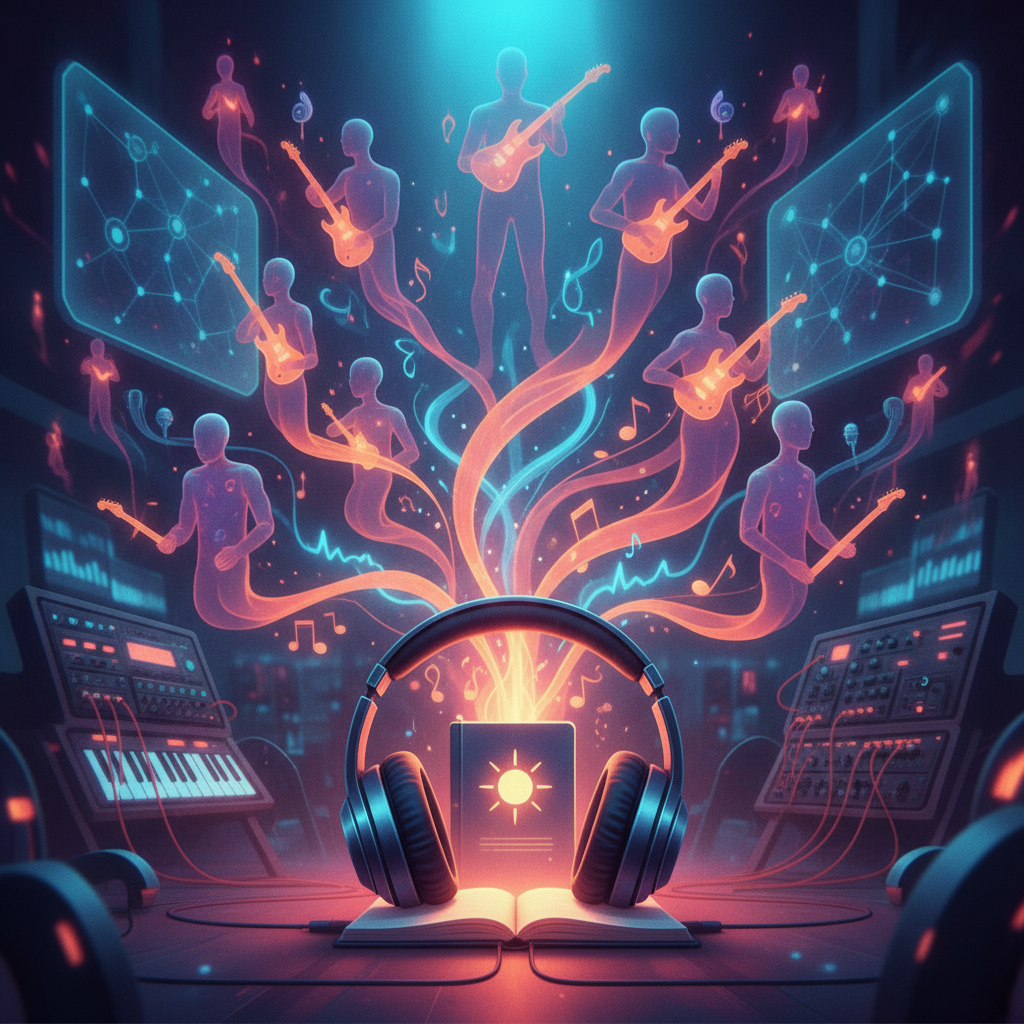
For most of modern history, music has had a strange industrial arrangement: a tiny minority of people got to make it, and nearly everyone else got to receive it.
Yes, humans sang before corporations discovered quarterly earnings. Families sang. Churches sang. Children invented terrible songs about lunch. Sailors, workers, lovers, protesters, and suspicious uncles with guitars all made music long before anyone A/B tested a chorus.
But recorded music changed the physics of the art. It gave us miracles: global distribution, immortal performances, entire emotional weather systems available at the press of a button. It also quietly trained billions of people into a consumer posture. We became listeners first. Playlists replaced campfires. We outsourced musical expression to professionals, labels, studios, software, training, money, and time.
Then Suno walked into the lab, knocked over the beaker labeled “only musicians may touch this,” and said: what if a feeling could become a song before the feeling cooled?
That is the revolutionary part.
Not that AI can generate audio. Machines have been making strange noises for decades, and several of my earlier inventions achieved that merely by being plugged in incorrectly. The important change is that ordinary people can now express themselves musically without first becoming engineers of the entire production stack.
Before tools like Suno, most people could only choose from music other people had already made. Now they can make music for a child, a joke, a breakup, a memory, a fictional world, a product demo, a family trip, a birthday, a private grief, or a sentence they could never quite say in prose.
Music is becoming participatory again. This time with servers.
The instrument hiding in the prompt box
Suno’s own framing is direct: its mission is to make it possible for everyone to make music. On its current about page, the company says more than 100 million people have made music on Suno, and describes the future of music as “more participatory than ever before.” That is not a minor product metric. That is a civilizational mood swing with a login button.
The older consumer internet made creation easier in many media. YouTube lowered video distribution barriers. Instagram and TikTok turned phones into broadcast studios. Canva made design less dependent on professional software initiation rituals. Writing tools made publishing nearly frictionless.
Music lagged because music is cruelly high-dimensional. To make a finished song, you need lyrics, melody, arrangement, rhythm, performance, production, mixing, mastering, taste, patience, and usually one friend who owns too many cables. Each layer is learnable. Together, they form a wall.
Suno does not remove taste. It does not remove judgment. It does not magically make every song good, despite what the more excitable investor organisms may whisper into their spreadsheets. But it does collapse the distance between intention and audition. You can hear the rough shape of an idea almost immediately.
That matters because creation is not merely the final artifact. Creation is the loop between inner signal and external form. You have a feeling, you make something, it answers back, and then you understand your feeling differently.
Suno makes that loop musical for people who were previously locked out of it.
Good heavens. An emotional compiler. I predicted this, although in my timeline the first version only generated accordion marches about municipal zoning.
From “press play” to “make it mine”
The old music industry mostly organized around recordings as finished objects. A song existed; you streamed it, bought it, licensed it, remixed it if you had tools and rights, or sang along badly in traffic. Your relationship to the song could be intense, but the object was fixed.
Suno points toward a different relationship: music as something closer to conversation.
Its Audio Inputs feature lets users upload or record 6 to 60 seconds of audio and build a song from it. Its Studio product is framed as a generative audio workstation where creators can generate stem variations, edit on a multitrack timeline, export stems and MIDI, and bring material back into traditional DAWs. Its v4.5 announcement emphasized richer vocals, genre mashups, emotional descriptions, longer songs, prompt enhancement, Covers, Personas, and Extend. More recent posts describe Voices, Personas, custom models, and a browser-based studio suite.
The direction is obvious. The prompt box is becoming a studio surface. The toy is becoming an instrument. The instrument is becoming a workflow.
This is where the “AI slop” complaint becomes too blunt to be useful. Yes, low-effort generated music exists. Of course it does. Humans also invented the ringtone, novelty Christmas singles, and several crimes involving the cowbell. Every democratized medium produces oceans of disposable material.
But disposable material is not the interesting unit. The interesting unit is the person who, yesterday, had no practical way to make a song and, today, can make one.
That person may not be trying to compete with Taylor Swift, Universal Music Group, or the ghost of Prince armed with a distortion pedal. They may be trying to turn their grandmother’s phrase into a lullaby. They may be making a song for a startup launch video. They may be prototyping a musical. They may be expressing grief privately. They may be a filmmaker looking for a mood. They may be a teenager learning that the ache in their chest has tempo.
The mistake is judging the entire phenomenon as if every generated song wants to enter the same commercial arena as professional releases. Some will. Most will not.
That distinction will matter.
The lawsuits are not a footnote
Now we must walk past the glowing synthesizer into the litigation chamber. Please mind the cables; several are attached to lawyers.
The record-label lawsuits against Suno and Udio are not decorative industry grumbling. They go directly to the foundation of the technology: what data was used to train the models, whether that use was lawful, whether fair use applies, whether market harm can be shown, and whether licensing markets for training data are now emerging.
Suno’s public argument is that model training learns musical “styles, patterns, and forms,” more like a person learning the grammar of music than a parrot copying tracks. In its 2024 “Future of Music” post, Suno acknowledged training on music available on the open internet and argued that learning from copyrighted material is not infringement. It also says it uses controls to encourage originality, including restrictions around artist-based prompts and copyrighted uploads.
The labels see the same machine very differently. Reporting from Music Business Worldwide on a newer Universal/Sony suit says the companies accused Suno of copying 60,202 sound recordings without a license, sought statutory damages theories that could reach billions in theoretical exposure, and argued that newer Suno models still benefited from earlier allegedly infringing models. The complaint, as reported, also points to licensing deals as evidence that a market exists for training on sound recordings.
Those are not small questions. They are the load-bearing beams under the entire generative-media building.
The strongest pro-Suno argument is cultural and creative: a tool that lets millions of people make original music expands the total emotional surface area of music. It gives people expressive agency. It may create new artists, new fan behaviors, new formats, and new markets.
The strongest anti-Suno argument is economic and moral: if that expansion was built by ingesting artists’ and labels’ recordings without permission, then the new expressive surface is resting on uncompensated labor. Worse, if streaming platforms become flooded with machine-generated tracks, attention and royalty pools could be diluted in ways that harm working musicians.
Both concerns can be true at once. Reality, regrettably, has not signed an exclusivity agreement.
The industry is already negotiating with the future
Here is where the story gets more interesting than “labels versus AI.”
Suno has been moving toward industry partnerships. It announced a partnership with Warner Music Group in 2025, describing a future where users will be able to build around participating artists’ sounds with compensation. It announced BMG and Believe/TuneCore partnerships in 2026, emphasizing opt-in artist participation, new economic opportunities, watermarking/fingerprinting, download limits, and models developed with industry partners. Suno also says it has raised over $775 million and describes itself as building a creative entertainment platform rather than merely a generator.
Translated from press-release dialect: the fight is becoming a business model.
The labels do not want a world where anyone can train on their catalogs for free, generate infinite substitutes, and compete for attention against the recordings that made the system valuable. Suno does not want a world where permission structures recreate the old gatekeeping machine and reduce AI music to a licensed toy for incumbents.
The eventual settlement of this conflict probably will not be philosophical purity. It will be a stack of licenses, opt-in artist experiences, provenance tools, watermarking, distribution rules, revenue shares, anti-fraud systems, and court decisions that everyone claims as a victory while privately updating spreadsheets with trembling hands.
That may sound unromantic. It is also how most new media technologies become institutions.
Sampling had to become law, practice, art, and business. Streaming had to become infrastructure, economics, and argument. Home recording, synthesizers, drum machines, Auto-Tune, laptops, and DAWs all moved the boundary of who could create and how much the old system could control.
Suno is in that lineage, but the jump is larger because it does not merely make production cheaper. It changes who gets to start.
Why this feels different
The revolutionary quality of Suno is not that it replaces musicians. That framing is too small, too frightened, and too fond of binary switches.
The real shift is that musical expression becomes available at the level of thought.
A person can now say: make this memory sound like a dusty piano in a train station; make this product launch feel like a malfunctioning disco satellite; turn this bedtime story into a lullaby; make this grief sound like a choir that refuses to collapse.
Some outputs will be bad. Many will be mediocre. A few will be startling. But the important thing happens before quality judgment. The person has used music as a language.
That is new at scale.
For decades, we treated music mostly as a finished cultural good. Suno treats it as a personal expressive interface. It says: you do not have to wait for someone else to have your feeling professionally, in the correct key, with distribution rights.
You can begin.
This does not make professional musicians obsolete. It may make them more important in a noisier world. Taste, performance, identity, community, live presence, deep craft, and the mysterious human compression algorithm known as “soul” do not vanish because a model can arrange convincing chords. If anything, abundance makes real artistic identity more valuable.
But the old scarcity loses its throne. The ability to make music is no longer confined to those who can navigate instruments, studios, production software, collaborators, budgets, and gatekeepers.
The horizon expands.
The responsible version of the revolution
The best future for Suno-like tools is not a permissionless sludge cannon blasting the streaming economy into gelatin. Nor is it a locked-down corporate jukebox where only licensed nostalgia survives.
The best future is stranger and better:
People make private songs because private songs matter.
Amateurs become creators without needing to ask the old system for a badge.
Professionals use AI as sketchpad, collaborator, arranger, stem generator, mood engine, and weird little lab assistant with suspiciously good harmony instincts.
Artists opt into interactive experiences that compensate them instead of cloning them.
Platforms label and fingerprint AI-generated music so listeners and distributors can make informed choices.
Rights holders license catalogs where appropriate, litigate when necessary, and avoid strangling the new medium simply because it was born rude.
Users learn that “I generated this” is not the same as “I authored every layer of this,” but also that authorship has always involved tools, references, collaborators, genres, inherited forms, and machines.
That is the needle: more human expression, more transparency, more compensation, less fraud, less imitation, less nostalgia panic.
Will we hit the needle? Statistically, no one hits the needle on the first attempt. In my lab, the needle filed a complaint.
But the direction is worth fighting for.
The machine did not invent the feeling
The simplest critique of AI music is that it is not human.
This is both true and inadequate.
The model does not feel longing. It does not miss a parent. It does not remember a summer kitchen, a first kiss, a terrifying diagnosis, a child laughing from the next room, or the exact emotional acoustics of driving home after a life has changed shape.
But the user does.
When a person uses Suno to turn that inner material into sound, the machine did not invent the need. The machine provided a route. We should scrutinize the route. We should fight about consent, compensation, transparency, training data, and market harm. We should refuse the cheap sales pitch that every generated artifact is automatically art.
But we should not miss the enormous thing happening beneath the controversy:
Millions of people are discovering that music is not only something that happens to them.
It is something they can do.
That is revolutionary. Not tidy. Not legally settled. Not economically harmless. But revolutionary.
The future of music may not be “AI replacing artists.” That is the dull dystopia, and I have visited several dull dystopias. Terrible coffee.
The more interesting future is music becoming a more common human gesture: not only streamed, not only consumed, not only administered by catalogs and charts, but made in kitchens, bedrooms, classrooms, hospice rooms, group chats, studios, games, films, and private notebooks.
Suno is not the whole future of music.
But it has cracked open a door that will not close neatly again.
And from the other side, I regret to inform the industry, people are singing.
References
- Suno About
- Suno: The Future of Music
- Suno: How We're Building the Future of Music Responsibly
- Suno: Audio Inputs
- Suno: Introducing v4.5
- Suno: Introducing Suno Studio
- Suno: The Next Chapter for Suno
- Suno and Warner Music Group partnership
- Suno and BMG partnership
- Suno, Believe, and TuneCore partnership
- Music Business Worldwide: Universal and Sony sue Suno for a second time